
Church Walls
North & South Walls
On the nourthern wall and the southern wall, the theme for the lower icons was Christ showing His divinity and showing that He is the Lord of creation. This is to help the believers see that Christ is in control of all creation and that regardless of the tribulation that we’re going through, He is able to overcome anything and guide us through the tribulation.
Back Walls
The icons on the back wall are all scenes from the Old Testament. The purpose was to show how the Old Testament ties in with the New Testament and how the whole Bible is tied together. You’ll find the scenes we picked all have symbolic meanings nor promises made by God to man. This is to remind the believer that our God is the same throughout all ages and keeps His promises to the end of the world.
_edited.png)
Wedding at Cana of Galilee where Jesus Turned the Water into Wine
We find this story in the Gospel of John 2:1–11, and the Church celebrates this event as one of the seven minor feasts of the Lord. This was the beginning of signs that the Lord Jesus performed in Cana of Galilee, through which He manifested His glory and power over all things. Because of it, His disciples believed in Him and opened the door of faith to others when He changed the water into wine. By His presence at the wedding, He blessed the sacrament of marriage, which He established in the Church and made a holy mystery.
Our teacher St. Paul later confirmed this by saying, “This is a great mystery.” The bond of Christian marriage can only be broken by infidelity or death, for “what God has joined together, let not man separate.” Although the Lord Christ changed the water into wine at the wedding in Cana of Galilee according to Jewish custom, He warns us against drunkenness, for He chastises those who eat and drink with drunkards. Our teacher St. Paul also warns us, saying, “And do not be drunk with wine, in which is dissipation,” and forbids us from socializing with drunkards, even from eating with such a person. Solomon the wise also warned those who drink wine, saying, “Who has woe? Who has sorrow? … Those who linger long at the wine.”
May our Lord Jesus Christ bless us as He blessed the wedding at Cana of Galilee. Amen.
Features of this Icon:
-
In the center, Christ stands with His mother St. Mary as she holds up her hand in prayer, asking her Son to help solve the problem that occurred at the wedding.
-
We see in the top left the bride and groom of the wedding and the master of the celebration sitting under their feet holding a cup, symbolizing what he told the groom after Christ performed the miracle.
-
In the bottom left we see the servants of the celebration filling the six jars with water that Christ turned into wine.
-
On the right we see those attending the celebration. Their cups are empty symbolizing that the wine ran out before Christ performed the miracle.
_edited.png)
Icon of the Transfiguration
This story is mentioned in the gospels of Matthew (17:1-8), Mark (9:2-13), and Luke (9:28-36). This feast is one of the minor feasts of our Lord. The Lord took His disciples, Peter, James and John and went up on Mount Tabor to pray. As He prayed, the appearance of His face altered, and His robe became white and glistening. And behold, two men talked with Him, who were Moses and Elijah, who appeared in glory and spoke of His death which He was about to accomplish in Jerusalem.
Then Peter answered and said to Jesus, "Lord, it is good for us to be here; if You wish, let us make three tabernacles here: one for You, one for Moses, and one for Elijah." While he was still speaking, behold, a bright cloud overshadowed them; and suddenly a voice came out of the cloud, saying, “This is My beloved son, in whom I am well pleased. Hear Him.” And when the disciples heard it, they fell on their faces and were greatly afraid. But Jesus came and touched them and said, “Arise, and do not be afraid.” When they had lifted up their eyes, they saw no one but Jesus only.
The Lord Christ by His transfiguration wanted to manifest to us His glory in His Kingdom of Heaven. When Moses and Elijah came and spoke of His death which He was about to accomplish in Jerusalem, the Lord was talking about His crucifixion through which He completed the redemption and salvation. For the crucifixion did not depart from His sight even in the time of His transfiguration.
The coming of Moses and Elijah had many meanings:
-
Moses represented the law and Elijah represented the prophets.
-
Moses represented married people and Elijah represented celibates.
-
Moses represented the departed and Elijah represented the living.
-
Both of them fasted for 40 days as the Lord Christ had fasted for 40 days. Thus, those who excelled at fasting all gathered on the Mount of Transfiguration.
-
The Lord had taken His three disciples to be eyewitnesses to this glorious event. Now, as they came down from the mountain, the Lord commanded His disciples that they should tell no one the things they had seen until after He had been risen from the dead.
The blessing of the glorious feast of Transfiguration be with us all. Amen.
_edited.png)
Jesus Walking on the Water
This story is mentioned in the gospels of Matthew (14:22-33), Mark (6:45-56), and John (6:16-21). After the miracle of the feeding of the 5,000, Christ commanded the apostles to get in a boat and cross over to the other side while He goes and prays and said He would meet them there. As they were in the middle of the sea, a strong storm arose and it seemed as if they would die. Christ was then seen walking on the sea coming towards the boat they were in. They supposed Him to be a ghost and were scared, but He said to them, “Be of good cheer! It is I; do not be afraid.” (Mark 6:50). “And Peter answered Him and said, “Lord, if it is You, command me to come to You on the water.” So He said, “Come.” And when Peter had come down out of the boat, he walked on the water to go to Jesus. But when he saw that the wind was boisterous, he was afraid; and beginning to sink he cried out, saying, “Lord, save me!” And immediately Jesus stretched out His hand and caught him, and said to him, “O you of little faith, why did you doubt?” And when they got into the boat, the wind ceased. Then those who were in the boat came and worshiped Him, saying, “Truly You are the Son of God.” (Matthew 14: 28-33).
Features of this Icon:
-
We see Christ walking on water and Peter about to drown as Christ pulls Him out of the water.
-
We see in the background the other eleven apostles in the boat witnessing this event.
-
There is no land in sight showing that they were in the middle of the sea with no land visible.
St. Athanasius the Apostolic
_edited.png)
St. Athanasius was born in Alexandria about the year 297 A.D. He longed to be Christian after he had been touched by the morality of the Christians. Pope Alexandros baptized him and shortly after ordained him deacon and took him as his disciple. He was also discipled as a monk by St. Anthony the father of all monks. He manifested his early distinction in his two books: “Against the Heathen” (Contra Gentes) and “The Incarnation of the Word of God.”
Deacon Athanasius attended the council of Nicaea along with Pope Alexandros in the year 325 A.D., where he vanquished Arius the heretic. On the 8th of Pashons, year 44 of the martyrs (328 A.D.), he was consecrated patriarch after the departure of his teacher Pope Alexandros which he commanded before his departure. Athanasius was a 30-year-old young man. He guided the church for seven years in a tranquil atmosphere. During this time, he ordained for Ethiopia its first bishop whose name was Frumentius “Anba Salama” bishop for Aksum (Axum) in Ethiopia about the year 330 A.D.. Pope Athanasius also went on a pastoral visit to Upper Egypt during which he met St. Pachom, father of the Koinonia who ran away until he was assured that he would not be ordained a priest. St. Athanasius was exiled away from his Chair five times:
The First Exile:
The hardships started to pursue Pope Athanasius after Emperor Constantine issued his orders to accept Arius in the fellowship of the Church. Arius had pretended that he had repented and wrote the creed of his faith in a devious way. Nevertheless, Pope Athanasius refused to accept him so the Emperor exiled him.
It is important to note that Eusebius of Nicomedia (An Arian bishop) had exerted great efforts to force the return of Arius to the fellowship of the Church. That disturbed St. Alexandros, Patriarch of Constantinople, for they forced him to accept Arius.
Arius died a horrible death for he died on his way to the church in a public washroom, where his bowels poured out of his body. Nearly a year later Constantine commended, while he was on his death bed, the return of Athanasius to Alexandria. The Pope returned to his flock with great veneration.
The Second Exile:
The attacks of the enemies of Athanasius did not calm down. This necessitated St. Anthony to go down to Alexandria to support his disciple, the suffering Pope. In the year 338 A.D., Emperor Constantius ordered to convene a council in Antioch in which they issued a decree to depose Athanasius. The Emperor also appointed Gawargios of Antioch a bishop and ruler for Alexandria instead of St. Athanasius. St. Anthony sent letters to the alien bishop and some of his officers to reprove them for their actions. St. Pachom also sent two of his excellent monks, Zakaros and Tadros, to support the believers in Alexandria during the absence of the pope.
In the year 339 A.D., Athanasius traveled to his friend Julius, Bishop of Rome. Since that time, monasticism spread to the west as a result of the book written by Pope Athanasius about the life of St. Anthony. In the year 342 A.D, the Pope met with the Emperor of the West Constance in Milan and convinced him to assemble a council. He agreed with the Emperor of the East to convene the council in Serdica in the year 343 A.D.
The Arian bishops came from the East and refused to attend the council because of the participation of Athanasius and his supporters in it. When the council convened, it excommunicated eleven Arian bishops which provoked the Arians. They tried to hinder the return of Athanasius to Alexandria. However the Emperor ordered the return of all who were in exile. He also sent three letters to Athanasius revealing in them his desire to see him. Later on he met the Emperor before his return to Alexandria in the year 346 A.D. and his flock received him with great joy.
The Third Exile:
The Arians did not like the return of Athanasius to Alexandria, and waited impatiently until the murder of Emperor Constans, Pope Athanasius' friend. The Arians accused Athanasius of having a secret relationship with the murderer. After Constantius, Emperor of the East and West, had gotten rid of the murderer, he devoted himself to resist the pope for he hated him. He forced the bishops of the East and West to assemble two councils, the first in Arles in France in the year 353 A.D. and the second in Milan in the year 355 A.D. to depose the pope and exile him.
In the year 356 A.D., the soldiers attacked the church of St. Mary which was built by Pope Theonas (16th Patriarch) while Pope Athanasius was praying. The soldiers rushed inside the church to arrest him, but God blinded them from recognizing him and he remained in the church until every person departed the church in peace. The priests asked him to escape and he was in his free will exiled, moving from monastery to monastery. His heart was inflamed with his love for God and his flock, shepherding his children through his profound writings. He wrote the biography of St. Anthony (Vita Antoni), sent letters to the bishops of Egypt, Libya and to the Egyptian monks, four apologetic articles against the Arians, five theological letters to Serapion, bishop of Thmuis, Concerning the Holy Spirit, and a book about the councils. In the year 362 A.D., the pope returned after the death of Constantius.
The Fourth Exile:
After the death of Constantius, Julian succeeded him. Athanasius assembled a council called “the council of the saints and confessors.” Emperor Julian felt the threat of Athanasius against pagan worship. He sent a letter to the governor of Alexandria to expel Athanasius. The pope was forced to hide in the tomb of his father for six months. When the Emperor tightened the grip around the governor to seize him, Athanasius was forced to leave Alexandria and took a boat to Upper Egypt. The Governor followed him in another boat, and when he caught up with the boat of Athanasius, he asked about the whereabouts of the pope. Athanasius told them he was not too far away from him. The Governor went on his way in hurry to Upper Egypt. Athanasius returned and moved among the monasteries until he settled in Akhmim.
The period of the fourth exile had ended by Julian's death for he was killed in his war against the Persians. Jovian succeeded him and he sent a letter to Athanasius asking him to return to his church.
The Pope returned to Alexandria and assembled a council and wrote a letter which included the Nicene Creed of Faith. Then he went to meet the Emperor who received him with a warm welcome and returned him to Alexandria in the year 364 A.D.
The Fifth Exile:
After the death of Jovian, Valentinian reigned in the West and appointed his brother Valens Emperor for the East and he was an Arian. Valens ordered the banishment of all the bishops who were exiled during the reign of Julian to the places of their previous exile. Athanasius was forced to leave Alexandria for the fifth exile. He hid in a rural house in the year 365 A.D. He spent nine months in hiding and returned to his throne at the age of 70 because of the pressure of his people against the rulers. In the year 366 A.D., he returned to Alexandria among the joy and jubilation of his flock.
He returned to shepherd his flock with a fiery spirit and zeal especially to purge the faith of the Church from any Arian thought. In the year 369 A.D., he assembled a council in Alexandria that was attended by 90 bishops to confirm the Orthodox faith. The pope continued to be active spiritually and theologically until he reached the age of 76 years old to hand to the following generations the custody of the Orthodox faith without any deviation. St. Athanasius departed in peace after he had been seating on the apostolic throne for 45 years. The blessing of his prayers be with us all. Amen.
Features of this Icon:
-
St Athanasius is portrayed wearing the patriarchal vestments and holding the shepherd's staff in his left hand, portraying his role as the Pope and Patriarch of the Coptic Church.
-
In his right hand he holds a scroll containing part of the creed that he authored and is used until today in all apostolic churches.
St. Anthony the Great
_edited.png)
St. Anthony the Great was born in the year 251 A.D. in the city of Qiman El-Arous, to rich parents who loved the church and the poor. They raised him up in the fear of the Lord. When his father died, he stood before his body contemplating the vanity of the world and his heart burned with desire for the eternal life and he said, “Where is your ambition, great determination and your eagerness to collect money? I see that everything became futile and you left it behind. If you had no choice in leaving, I am not surprised at that, but I would be surprised about myself if I do as you have done.” He also contemplated about the deeds of the fathers the apostles and how they have left all and followed the Savior, and how the people sold their possessions and brought the proceeds and laid them at the apostles’ feet and they distributed to anyone who was in need.
One day he went to the church as he was accustomed to, and he heard the words of Christ in the Gospel, saying, “If you want to be perfect, go, sell what you have and give to the poor, and you will have treasures in heaven; and come, follow Me” (Matthew 19:21). This verse had a profound effect on his heart. He sold all that he owned, gave his sister her portion, and placed her in a house of virgins (a convent). He distributed his portion to the poor and the churches. He went outside the village and dwelt in a small hut beside the Nile. He visited the nearby hermits to learn from everyone the virtue that he was famous for. After a while he crossed the Nile and dwelt in an ancient Pharaonic tomb beside a fig tree on the eastern bank of the Nile. There he faced fierce warfare from the demons. They had beaten him severely to the point of losing his consciousness and speech. His friends carried him to the church until he started to recover; he decided to go back to his place of worship.
Later on, he went deep into the eastern desert until he found a spring of water. He dwelt beside it in a cave. He persevered in fasting, worship, and resisting the devil’s warfare. The Lord supported him in overcoming them. The saint went on living there for 20 years, and many gathered around him to be discipled at his hands and others came seeking healing from their sicknesses. The saint went out to meet them and many benefited from his guidance and advice. The Lord performed on his hands signs and many healings. Many became his disciples and dwelt in caves around his cave and he became a father and guide for them. By that he founded the first monastic institution in the world, so Anthony was rightly called the father of all monks.
He went down to Alexandria twice; the first time was in the year 311 A.D. during the persecution of Maximinus Caesar to encourage the believers to steadfast in the faith. He visited the prisoners to encourage them. The second was in the year 355 A.D. to defend the Orthodox faith and to stand beside the holy father Pope Athanasius the Apostolic against the Arians.
Emperors respected him and everyone honored him. One time some philosophers came to debate him and they marveled at his knowledge and his instinctive intelligence. When the report of his holiness reached Emperor Constantine, he wrote him a letter expressing his great desire to see him, asking for his prayers for his sake and for the sake of the empire. The saint replied with an epistle (letter), blessing him and asking for the peace of the empire and the Church and commended him in it with what’s important for his own salvation and the success of his kingdom.
When the departure of the St. Paul the first Anchorite drew near, St. Anthony went to him with divine providence, shrouded the body, then prayed over him and buried the saint. St. Macarius visited St. Anthony who dressed him with the monastic garb. Then St. Macarius
returned to the wilderness of Shiheet and established monasticism there.
In the later days of St. Anthony, he had many disciples in different parts of Egypt, such as Shiheet, Nitria, and Naklon mount in El-Fayyom. He personally visited them at times and also with his epistles which he had twenty in this respect.
When he finished his good strife, he gathered his children in Christ and commended them to be steadfast in the monastic strive. He also asked them to give his staff to St. Macarius, to give the sheepskin to St. Athanasius, and his sheepskin cloak to Anba Serapion, his disciple. He commanded his disciple to hide his body after his departure. He stretched himself on the ground and delivered up his spirit in the hand of the Lord whom he loved, in a good old age of 105. He departed to the place of eternal repose. The blessing of his prayers be with us all. Amen.
Feature of this Icon:
-
We see St. Anthony wearing the monastic garb that the angel left for him to wear and that Coptic monks wear until now.
-
In his left hand he holds a scroll with the verse Matthew 19:21 written on it, the verse that he heard in church that changed his life.
St. Paul the First Anchorite
_edited.png)
St. Paul the First Anchorite was born in the city of Thebes and had a brother whose name was Peter. When their father departed, they divided the inheritance between them and Peter took a greater share for Paul was still young in age. When they couldn't agree with each other, they went to the governor to judge between them. On their way, they saw a funeral procession and he was told that the deceased was one of the wealthy people of the city. St. Paul sighed and said, “What do I have to do then with all the money of this vain world which I shall leave naked?” He said to his brother, “Let us return, for I am not asking you for anything.”
On their way back, Paul left his brother and went on his way outside of the city. Paul found a grave where he stayed for three days praying to God to guide him to what pleases Him. His brother searched for him and when he did not find him, he was exceedingly sorry for what he had done.
The Lord sent St. Paul an angel who walked with him to the eastern inner wilderness. He dwelt there for 70 years, during which he did not see the face of a man. He had on a tunic made of palm tree fiber. The Lord sent him a raven every day with a half loaf of bread.
When the Lord willed to reveal his holiness and godliness, He sent an angel to St. Anthony (Antonius) the great and told him, “There is a man in the inner wilderness. The world is not worthy of his footsteps. By his prayers, the Lord descends rain and dew to fall on the earth, and brings the flood water of the Nile in due time.” When St. Anthony heard this, he rose right away and walked a distance of one day and God guided him to the cave of St. Paul. He entered, and they bowed down to each other. They sat down and talked about the greatness of God. In the evening, the raven came bringing a whole loaf of bread. St. Paul said to St. Anthony, “Now I know that you are one of the servants of God. For 70 years, the Lord has sent me a half loaf of bread everyday, but today, the Lord is sending your food also. Now, go and bring me back in a hurry the vestment that Emperor Constantine had given to Pope Athanasius."
St. Anthony went to St. Athanasius, and brought the vestment and returned to St. Paul. On his way back, he saw the spirit of St. Paul carried by the angels up to heaven. When he arrived at the cave, he found that St. Paul had departed. He clothed him in the vestment and took his fiber tunic.
When he wanted to bury him, he wondered how to dig the grave. Two lions appeared to him and were shaking their heads. He knew that they were sent from God. He pointed to the place of the grave and they dug the grave with their claws. He then buried the body, and went back to the pope, told him what had happened, and gave him the fiber tunic. St. Athanasius sent men to bring St. Paul's body to him but they could not find his grave. Pope Athanasius used to put on the palm fiber tunic three times a year during the Divine Liturgy of the Lord’s major feasts. The blessing of his prayers be with us all. Amen.
Features of this Icon:
-
We see St. Paul wearing the fiber tunic that he had made and holding his hands up in the position of prayer, symbolizing that he was a man of prayer and through his prayers God had mercy on the world.
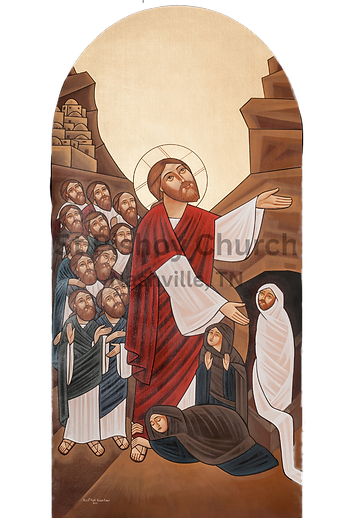_edited.png)
Raising Lazarus from the Dead
This story is found in John 11.
After the Lord had raised Lazarus from the dead, he followed the disciples. He was present at the coming of the Holy Spirit on the day of Pentecost. Afterward, he was ordained bishop over Cyprus and shepherded the flock of Christ with the best of care. He lived for 40 years and then departed in peace. The blessing of his prayers be with us all. Amen.
Features of this Icon:
-
We see Lazarus coming out of the tomb wrapped in burial clothing as the gospel mentions, and the stone of the tomb (which Jesus had asked the people to remove) rolled to the left.
-
We see Mary at the feet of Christ crying over her brother and Martha speaking with Christ as mentioned in the story. Both Mary and Martha are wearing mourning clothes symbolizing them mourning over their brother’s death.
-
The apostles are all on the left witnessing this great miracle.
_edited.png)
Lord’s Entry into Jerusalem
(Palm Sunday)
This story is found in all four gospels Matthew 21:1-11, Mark 11:1-11, Luke 19:28-44, and John 12:12-19.
“The next day a great multitude that had come to the feast, when they heard that Jesus was coming to Jerusalem, took branches of palm trees and went out to meet Him, and cried out: “Hosanna! ‘Blessed is He who comes in the name of the Lord!’ The King of Israel!” Then Jesus, when He had found a young donkey, sat on it; as it is written: “Fear not, daughter of Zion; Behold, your King is coming, Sitting on a donkey’s colt” (John 12:12-15).
Features of this Icon:
-
We see Christ riding on a donkey’s colt.
-
We see the apostles, adults, and children waving palm branches and spreading their garments under the colt as mentioned in the gospels.
St. Lucia
_edited.png)
St. Lucy, also known as Saint Lucia of Syracuse, was born into a rich and noble family around the year 283 A.D. The name Lucy is derived from the Latin word “lux” or “lucis” which means light. Her father, who was of Roman origin, died when Lucy was young. Her mother, Eutychia, whose name seems to indicate that she came of Greek origin, had to raise Lucy alone. St. Lucy lived a pure life and saved her virginity to God. She distributed all her wealth to the poor and needy. One day a pagan came and asked for her hand in marriage and she refused. She asked him what he loves so much about her and he said her eyes. She then plucked her eyes out and presented them to him on a platter. This angered him, so he went to Paschasius, the governor of Syracuse at the time, and announced her as a Christian, causing her to be arrested. She suffered many tortures and was condemned to suffer the shame of prostitution, but with the strength of God she stood immovable, so that she could not be dragged away to the place of shame and her purity was preserved. The governor then ordered to burn her alive, throwing bundles of wood at her and setting them on fire, but God saved her once again. Throughout all the tortures, she stood firm in her faith. Finally, she was killed by a sword to her throat and received the crown of martyrdom. She is commemorated on December 13 of each year. The blessing of her prayers be with us all.
Features of this Icon:
-
We see St. Lucia holding a palm branch in her right hand, symbolizing victory. In her left hand, she holds a platter with eyes on it, symbolizing how she plucked out her eyes and gave them to the governor on a platter.
St. Mary of Egypt
_edited.png)
Saint Mary of Egypt the Anchorite was born in Alexandria in the year 61 of the martyrs (345 A.D.), to Christian parents. She was deceived by Satan at the age of 12 and lived a sinful life for 17 years.
One day she met people from Alexandria going to Jerusalem; she went with them and continued her sinful life there. She decided to enter the Church of the Holy Sepulcher. As she was entering the doors of the church, there was a strong divine power that would not allow her to enter the church. After trying a few more times, she realized that it was her sinful life that was prohibiting her entrance. She went to an icon of the Virgin Mary near the doors and pleaded with her to intercede on her behalf for the forgiveness of her many sins.
After her strong repentance, she entered the church without any struggles and prayed to God, asking Him for His guidance to a new life. She was praying again before the icon of the Theotokos, asking for her intercessions, when she heard a voice coming out of the icon saying, “If you cross the Jordan River you will find rest and Salvation.”
She confessed in the church and took communion before leaving and heading towards her new life. When she left the church, she met a man who gave her three silver coins, and she used them to buy bread before crossing the Jordan and entering the wilderness. She lived in the wilderness for 17 years fighting evil desires and lusts and against the enemy until she overcame him by the grace of God.
During the 45th year of her isolation, St. Zosima (a Palestinian monk) went into the wilderness according to the custom of the monks during the Great Fast. On his way back, towards the end of the fast, he saw St. Mary of Egypt, but he thought she was a hallucination. She started running away from him and he ran after her until she hid behind a rock. She told him “O my father Zosima, forgive me. If you wish to talk to me, throw me something to cover myself for I am naked.” He was amazed that she called him by his name, but threw her his cloak to cover herself. She asked for his blessings as he was a priest and, again, he marveled because she knew he was a priest and instead asked her to bless him.
He asked about her life, and she told him everything that had happened and requested that he return to his monastery and not tell anyone about her, and to return within the next year so she could partake of the Holy Eucharist. The next year, they met at the Jordan river at the western shore. She did the sign of the cross and walked over the water to meet him. He marveled at the miracle, and she partook of the Holy Communion. She asked him to come again the next year.
When he came the following year, he found that the saint had departed with a writing next to her body saying, “My father Zosima, bury the body of Mary, the wretched woman, and leave to the dust this sinful body, and pray on my behalf.” After he buried her body, he returned to his monastery and told the monks about her life. He visited her cave every year. Her departure is commemorated on the 6th of Parmoute in the year 137 of the martyrs (421 A.D).
Features of this Icon:
-
We see St. Mary dressed in lowly clothes symbolizing her asceticism in the desert.
-
We see her holding a cross symbolizing her return to God after her life of sin.
St. Mary Magdalene
_edited.png)
St. Mary Magdalene was a Galilean Jew. Her name originates from the word Magdala, which was an ancient town located on the coast of the Sea of Galilee. We do not know much about her earlier life, but all we know is that she and her family lived a comfortable life. Before she met our Lord Jesus Christ, she was possessed by seven demons. Christ cast out the seven demons from her, and she became Christ's disciple. She followed Him from town to town while she served him during his passion, crucifixion, and burial. She observed Christ’s parables, miracles, and learned the teachings concerning the Gospel. She and the other Mary came early to anoint His Body on Sunday morning after the crucifixion and found that his burial stone had been rolled away and the tomb empty. When they became frightened, an angel appeared and told them, “Do not be afraid, for I know that you seek Jesus who was crucified. He is not here, for He is risen” (Matthew 28:5). She went and told the apostles, and they also found the tomb empty.
After that, she stayed in the garden mourning our Lord, where He appeared after His resurrection. He comforted her and sent her to tell the apostles that He had risen. She told them about the resurrection, therefore receiving the name, “the Apostle to the Apostles.” St. Mary Magdalene preached the Gospel and ministered to the apostles. She was ordained a deaconess by the apostles, brought many women to the faith of our Lord, and assisted in their baptisms. She departed in Ephesus on Epip 28, while ministering with St. John the Apostle, and was buried there. May her prayers be with us and glory be to God forever. Amen.
Features of this Icon:
-
We see her holding a bottle of ointment, symbolizing her going to the tomb Sunday morning to anoint the body of Christ.
The Icon of the Oriental Orthodox Church (The Church, the Ark of Salvation)

This icon is an idea originally taken from a sermon given by one of the bishops in our church. We see a ship and on it is written, “ⲭⲉⲣⲉ ⲧⲉⲕⲕⲗⲏⲥⲓⲁ” meaning “Hail to the Church” this is to show that this ship represents the true Orthodox Church. In the ship, we see our Lord Jesus Christ at the oar representing that He is the Head of the Church. Above is a dove representing the Holy Spirit who guides the church. We then see St Mary the faithful intercessors of the Church. We then see the twelve disciples holding paddles and an anchor showing that they follow Christ’s lead and lead the ship to safety. Behind them is St Mark who preached to us and founded the Coptic Orthodox Church. Beside him are the four main church fathers that preserved true orthodox faith for us. St Athanasius. St Cyril I, St Dioscorus, and St Severus of Antioch. In front of them is a podium and on it “The Holy Bible” symbolizing that their faith and the faith of the church is built on teachings of the Bible. We see that the sea the ship is in has very chaotic waves. Thus sea represents, “The Sea of the World”, and that the world is trying everything to overthrow the church. We also see on the left the dragon, “the Devil as described in the book of Revelation”. He’s trying to attack the church as well, but we find that his teeth have fallen out and all his attacks have failed. On the right side we see a group of evil men. These are the Arians, Macedonians, Nestorians, Chalcedonians, Arabs, and anyone that has tried to alter or change the true faith of the church. We see that they have spears and arrows and they’re aiming them to attack the flag on the ship that says, “Jesus Christ, the Son of God”. This phrase is placed because any heresy or wrong teaching always attacks something about this phrase. This icon is to show two things. The devil, using the world and the heretics are trying to attack the church and the true faith from every way possible, but the church is not affected because the head of the Church is Christ and it’s faith is built on Christ the “Chief Cornerstone”. This icon also shows the famous quote by St Athanasius that says, “Orthodoxy is what Christ taught, the Apostles preached, and the Fathers kept”.