
Iconostasis
The Iconostasis
The Iconostasis is the wooden structure that stands between the altar area and the rest of the church. In the early Coptic Church, there was no Iconostasis. Church icons were written directly on the walls as frescoes. However, as time passed and persecution increased in Egypt following the Arab Conquest, churches were often attacked even during the liturgy. In addition, church vessels made of silver or gold were frequently targeted for theft at night.To protect both the Holy Mysteries and these sacred vessels, the Church began constructing the Iconostasis from small pieces of wood. This design served a practical purpose: if the structure was ever destroyed, the individual pieces could be reassembled easily. Over time, the Iconostasis became a standard feature of Coptic churches. Eventually, a specific arrangement of icons was established upon it to guide and inspire believers during prayer.The icons on the iconostasis in every Coptic Orthodox church are arranged according to the procession of the cross, which happens three times a year. This order includes the top of the iconostasis, the left, and the first two icons on the right. Following the icon of St. John the Baptist is the icon of the church’s patron, St. Pishoy. After that, we chose to have the icons of St. Marina and St. Rebecca to show two examples of women who bore witness to Christ in two different ways. One was a young virgin, and the other was a widow with five kids. Though they chose different paths, both ultimately led them to Christ.We also chose to include examples of Old Testament prophecies and their New Testament fulfillment, such as Jonah in the belly of the whale and Christ’s Resurrection. Finally, we portray the story of the flight of the Holy Family into Egypt.


Icon of Christ
Christ is wearing red and white, symbolizing His redemptive work and His Resurrection to confirm His wondrous salvific work for mankind. Around His head is written in Coptic, "Our Savior Jesus Christ."
His right hand is lifted with one finger pointed up as a sign of blessing.
We also see the back of the throne blue with stars symbolizing the verse that says, "Heaven is My throne, And earth is My footstool" (Isaiah 66:1).
We see grapevines and wheat around and under the throne, symbolizing the Eucharist.

Icon of the Theophany
This event in Greek is called the Theophany (Theophania) or manifestation of the Divine Nature of the Lord. In 31 A.D., our Lord Jesus Christ, to whom be glory, was baptized at the hands of St. John the Baptist in the Jordan River. This story is found in all four gospels, Matthew 3:13-17, Mark 1:9-11, Luke 3:21-22, and John 1:29-34.
The Holy Trinity was clearly revealed to everyone during our Lord’s baptism; the Father in heaven saying, “This is My beloved Son, in whom I am well pleased,” the Son standing in the Jordan River, and the Holy Spirit descending like a dove and alighting upon Him. The glory of our Lord Jesus Christ was also manifested for he did not reveal himself in the previous thirty years until He revealed Himself to the people of Israel.
The Lord Jesus Christ established with His baptism the sacrament of Baptism, the first of the sacraments and the entry door to the kingdom of God. “He who believes and is baptized will be saved” (Mark 16:16) when he keeps his baptismal covenant with unceasing repentance and good deeds.
We thank our God who made Himself of no reputation and came in the likeness of men and established for us the road to Eternal Life. To Him is the everlasting glory forever. Amen.
Features of this Icon:
-
This icon depicts our Lord Jesus Christ being fully immersed under the water as this is part of our dogma in the Orthodox church that Holy Baptism has to be through full immersion under the water.
-
We see beneath Christ’s feet a serpent being destroyed, symbolizing the fulfillment of the prophecy found in Genesis which states, “And I will put enmity Between you and the woman, And between your seed and her Seed; He shall bruise your head, And you shall bruise His heel” (Genesis 3:15).
-
We see St. John the Baptist clothed in camel’s hair, as described in the Gospels, and wearing a red sash that symbolizes his martyrdom.
-
On the left, angels symbolize Malachi 3:1 which states, “Behold, I send My messenger (angel), And he will prepare the way before Me.”
-
The tree with seven fruits symbolizes the number of perfection and the axe next to it symbolizes the words St. John the Baptist spoke, as found in Luke 3:9: “And even now the ax is laid to the root of the trees. Therefore every tree which does not bear good fruit is cut down and thrown into the fire.”

St Pishoy
This holy father, St. Pishoy, was born in Shansha, Monufia governorate in the year 320 A.D. His father died and his mother raised him along with his five brothers with a true Christian upbringing. An angel once appeared to his mother in a vision, and said to her, “The Lord says to you, ‘Give Me one of your children to be My servant.’” She answered, “Whomever the Lord wants, He may have.” So the angel placed his hands on Abba Pishoy. The mother objected, saying, “His body is frail. Choose a stronger one.” The angel told her, “The strength of the Lord is made perfect in weakness.”
When he was twenty years old, he went to the wilderness of Shiheet and became a monk under the guidance of Anba Pemwah. He devoted himself to worship and asceticism for a period of three years. During this time, he grew in piety and his heart was kindled with God's love. After the departure of his teacher, he secluded himself in a cave where he tied his hair with a rope to the ceiling of the cave so if sleep overcame him, he would be jolted awake.
He fasted a week at a time and memorized many of the books of the Holy Bible, especially the book of Jeremiah. Jeremiah the prophet appeared to him often to explain to him what was difficult to understand.
Our Lord Jesus Christ appeared to him and told him, “O My elect Pishoy, peace be unto you. I have looked upon your toil and labor, and I shall be with you.” St. Pishoy replied, “It was You, O Lord, who labored in me. I have not toiled at all.” On another occasion, the Lord told him, “Rejoice my chosen Pishoy! Do you see this mountain? It will be filled with monks who will worship Me.” The saint asked Him, “Would you sustain them, O Lord?” The Lord replied, “If they love Me and keep My commandments, I will sustain them.”
Another time, the Lord Christ appeared to him as a sojourner, and St. Pishoy welcomed Him as a guest. He took water and washed His feet, and He recognized that He was the Lord Christ from the marks of the nails on His feet. Then the Lord comforted him and blessed him. The saint drank from the water, and when his disciple came, St. Pishoy asked his disciple to drink also. When the disciple tarried, he found the pot empty. The disciple regretted disobeying his teacher.
The fathers expressed their wish to see the Lord as St. Pishoy did. The Lord promised to appear to them on a mountain on a certain day.
When the day arrived, everyone rushed to meet the Lord. However, the saint was far behind the rest due to his old age. On their way, they passed by a man who was trying to join them but had great difficulty because of his old age; he asked them to carry him that he might also see the Lord, but they refused for fear of delay. When St. Pishoy came along, the old man asked him to carry him as he had asked the others. The saint carried the old man, walking with him on his back. Amazingly, the saint did not get tired.
When the load started to get heavier, he realized that he was carrying the Lord Christ. St. Pishoy looked at Him and said, “The heavens cannot contain You and the earth is shaken by Your majesty, so how can a sinner like me carry You?” The Lord said to him, “Because you have carried Me, O My beloved Pishoy, your body will never see corruption.” When the brethren learned what had happened, they were sorrowful that they had passed by the old man and not recognized that He was the Lord Christ. Thus, they lost their chance to meet the Lord who appears to those who have mercy upon the weak and needy.
St. Ephraim the Syrian visited him, and they talked about the greatness of God without an interpreter. St. Ephraim left his staff near the cave of St. Pishoy, and it grew to be the tree of St. Ephraim. When one of the monks knew of the presence of St. Ephraim, he came in haste to receive his blessing. However, St. Pishoy told him that a cloud had carried St. Ephraim away. The tree of St. Ephraim is still present in the Syrian Monastery.
St. John the Short also came to visit Anba Pishoy. Standing outside his cell, St. John heard St. Pishoy carrying on a conversation with someone, but when he entered the cell, he found St. Pishoy alone. He asked Anba Pishoy to whom he had been speaking. St. Pishoy told him, “Emperor Constantine came and told me, ‘Had I known how great is the honor of monks, I would have abandoned my kingdom and have become a monk.’” St. Pishoy responded to the Emperor, “You banished heathen worship and exalted Christianity. Has not Christ given you anything?” The Emperor replied, “The Lord has given me many gifts, indeed, but none of them like the honor of monks.”
St. Pishoy left Shiheet and went to Ansena during the first Berbers raid in the year 407 A.D.. There he dwelt with Abba Paul of Tammoh, and the two were not separated even after their repose.
When he completed his struggle, St. Pishoy departed this life in the year 417 A.D. and was buried in the fortress of Meniet el-Saquar near Ansena. During the papacy of the Anba Joseph (Yousab) I, the 52nd Patriarch, in the ninth century, the body of St. Pishoy, together with the body of St. Paul of Tammoh, was returned to his monastery in the wilderness of Shiheet.
The blessing of his prayers be with us all.
Features of this icon:
-
This icon depicts the famous story mentioned above where Christ visited St. Pishoy as a stranger and St. Pishoy took Him in and washed His feet.
-
While he was washing the stranger's feet, he saw the wounds in His feet. He looked up and saw that the man was Christ.
-
We see Christ leaning in and embracing St. Pishoy showing His love and care for him.

St Marina the Martyr
St. Marina was one of the daughters of the nobles of Antioch, Pisidia in Asia Minor. Her parents worshipped idols. When her mother died, her father entrusted her to a Christian nanny to raise her. This nanny read to Marina the biographies of the martyrs and taught her about the happiness they received in eternal life. Marina longed to be martyred in the name of the Lord Christ.
One day the governor saw Marina and greatly admired her. He wanted to marry her, but when he found out that she believed in the Lord Jesus Christ, he was disturbed and asked her to worship the idols. She utterly refused, but he tried to persuade her to obey him so that he would marry her. When she refused his persuasion, he became angry and ordered to comb her body with sharp iron combs. He then rubbed her wounds with vinegar and lime and imprisoned her. The angel of the Lord appeared to Marina and healed all her wounds.
The next morning, the Governor ordered for her to be brought to him. When he saw that she was well, he marveled exceedingly and ordered to hang her on the Hinbazeen and to tightly squeeze her. The Hinbazeen (or squeezing press) was a method of torture used to punish Christian who refused to worship other gods. Once again, the angel of the Lord came and healed St. Marina. He cast her in a large cauldron filled with boiling melted lead; however, the angel of the Lord saved her. Many believed because of her and received the crowns of martyrdom.
When the governor became weary of torturing her, he ordered to behead her. She extended her hands, prayed, bent her head down with great courage to the executioner who beheaded her, and received the crown of martyrdom. The Lord manifested from her pure body many wonders. Her body is still present in the church of the Virgin St. Mary in Haret El-Rum, Cairo. The blessing of her prayers be with us all. Amen.
Features of this Icon:
-
St. Marina holds a palm branch symbolizing triumph as she triumphed over tribulation and death through Christ. The palm branches symbolizing victory can be found in Revelation 7:9. In her other hand is a spear with a cross at the top and that spear being thrust into the devil symbolizes her victory over the devil through the cross.
-
St. Marina wears red to symbolize the shedding of her blood for Christ, white symbolizing her purity, and blue symbolizing that she looked at the heavenly and not the earthly.

St Rebecca and her Five Children
St. Rebecca (Refqa) and her five children, Sts. Agathon, Peter, John, Amun, and the child Amuna were from Kamola, district of Kus. When they heard that Emperor Diocletian had ordered to persecute the Christians and close the churches, they stood all night in prayer. They entreated the Lord Jesus Christ to have mercy on His people and to lift all evil away from them. While they were praying, the Angel of the Lord appeared to them to announce that they will receive the crown of martyrdom in the name of the Lord Christ. The saints rejoiced at this vision, and they rose up early and gave all their possessions to the poor and released all their servants.
They came to the city of Kus and confessed their faith in Christ before Dionysius, the Governor. He tortured them severely, starting with their mother who bore the torture patiently and with joy, and then he tortured her five children. She strengthened her children and encouraged them to endure the tortures. When he was weary of torturing them, he was advised by those around him to send them to Alexandria so that they might not lead other people in their city astray, for they were loved by everyone. Because of them, many confessed their faith in the Lord Christ and received crowns of martyrdom.
When they brought the saints before Armanius, the Governor of Alexandria, who was in a city called Shoubra, near the city of Damanhor, and learned about their story, he tortured them severely with the Hinbazeen, a….
Then he cast them into a cauldron filled with boiling oil. Through all these tortures, the Lord Christ strengthened them and made them whole. The governor and his people became weary, so he ordered to behead them with the sword and have their bodies thrown in the sea. They were beheaded and received the crowns of martyrdom.
They placed their bodies in a boat to cast them in the sea. The Lord sent forth His angel to a rich man from Nakraha, which is a village near Damanhor, told him about the saints and commanded him to take their bodies. The man was exceedingly glad. He came to where the bodies were, gave the soldiers much silver and took the holy bodies and laid them in the church.
God manifested from their relics many signs and wonders. When the village of Nakraha was ruined over time, they relocated the holy bodies to another town called Deey. When that city was also ruined, a monk moved the bodies from there to the city of Sonbat, where there is now a church known as "El-Sitt Refqa and Her Five Children" (Lady Rebecca). The bodies of these saints are still in this church to the present time and many visit this church every year to receive their blessings. The blessing of their prayers be with us all. Amen.
Features of this Icon:
-
St. Rebecca embraces all her children under her arms. This depicts the love she has for her children as their mother as she shows her love and care for them.
-
St. Rebecca and her children are either holding crosses in their hands, have a cross hanging from their necks, or are holding palm branches. The crosses symbolize their faith and the palm branches symbolize triumph as, through Christ, these holy saints triumphed over tribulation and death (Revelation 7:9).
_edited.jpg)
St Mina (Menas)
St. Mina was born in Nikiu (Niceous) around the middle of the third century. His father, Eudoxius, was the governor of the city of Nakyos (Nikiu), and his mother's name was Euphemia. His brother Anatolius was envious of him and brought accusations against him before the Emperor. As a result, the Emperor transferred him to serve as governor in the District of Marriot, north of Africa. The people there were pleased with him because he was merciful and God-fearing.
His mother, Euphemia, was a pious woman who prayed and fasted diligently. Because she was barren, she often entreated the Lord Christ to grant her a godly child. She fasted until evening and gave generous alms to the poor and the needy.
On the feast of Dormition of the Holy Virgin (21st of Tobe), she went to the church of the Virgin at Attribes. She saw the multitudes entering the church in joy and jubilation and the mothers joyfully carrying their children. She heaved a sigh and wept before the icon of Our Lady St. Mary, entreating her to intercede before God to grant her a son. She heard a voice coming out from the icon saying, “Amen.” She rejoiced in what she had heard. After the end of the Divine Liturgy, she returned to her home and told her godly husband Eudoxius about it, he rejoiced with her and said, "Our confidence in our God is great that He can fulfill, as you have heard."
Shortly after, St. Euphemia conceived and she thanked God for this blessing. At the birth of the child, they wanted to call him Blodianus after the name of his grandfather but his mother refused because of the word “Amen” that she heard from the icon of the Holy Virgin. She called him Mina, saying that the name Mina has the same letters as “Amen.” There was joy and jubilation for his birth. Eudoxius gave many charities to the poor and the needy to celebrate this happy occasion.
Mina’s parents greatly cared to rear him up in a spiritual manner and instructed him with the church teachings. They always encouraged him to read the Holy Bible and frequently took him to the church. So, he grew in piety and moral excellence.
When he was 11 years old, in the year 296 A.D., his father departed at a good old age. Then, his mother departed three years later. Mina inherited a great fortune, distributing much of it to the poor and needy.
About the year 300 A.D., he was enlisted in the army. Because the commander was a friend of his father, he made him the second in command and everyone loved him for his gentleness and piety.
The two emperors, Diocletian and Maximianus, issued their edict commanding the worship of idols and persecuting the Christians. Accordingly, St. Mina left his position and distributed the rest of his wealth to the poor and the needy. He went to the desert to be able to enjoy the divine commune with God in pure worship. He stayed in the wilderness for about five years worshipping God with many fasts and prayers by day and night.
One night, he heard a voice asking him to go to the city and confess the Lord Christ before the governor. The voice also foretold him that he would receive three crowns: one for virginity, one for worship and asceticism, and a third for martyrdom. When Mina heard this voice, he left the wilderness and returned to the city and publicly confessed the name of the Lord Christ before the governor and in the midst of a great multitude of people. The governor was very amazed and ordered to apprehend and imprison him.
The next day, he brought him and tried to persuade him, since he realized his noble kinship, to worship the idols. He promised him honors and precious gifts, but the saint answered with all humility, saying, “My only request from my God is to keep my life from corruption and to grant me the unfading crown.”
When the governor failed to persuade him to worship the idols, he started to torture him with many different tortures. He flogged him with an ox tail, hung him on the Hinbazeen, tore his body with hot iron rods, rubbed his wounds with haircloth, placed a burning torch to his side, and then threw him in prison.
The Lord Jesus Christ our Savior appeared to him, comforted, encouraged him, and healed his wounds. When the governor became weary of torturing him, he wrote his decree, ordered to behead him and burn his pure body in fire. The soldiers took him to the place of execution where he raised his eyes to heaven and prayed a fervent prayer then extended his neck before the swordsman who beheaded his holy head. Thus, he received the crown of martyrdom.
When they tried to burn his pure body, he stayed in the fire for three days and three nights and the fire did not harm him in any way. Some believers came and took the body from the middle of the fire, shrouded it with expensive shrouds, and buried him with great veneration.
The blessing of the prayers of St. Mina be with us all. Amen.
Features of this Icon:
-
St. Mina is depicted raising his hands in prayer as he lived in the desert for five years praying and living the life of asceticism. It also serves as an example for us to live the life of prayer. Through prayer, we can overcome anything.
-
He is depicted wearing white and red: white to symbolize his purity and red to symbolize his martyrdom.
-
On the bottom right of the icon, we see palm trees. As Psalm 92:12 states, “The righteous shall flourish like a palm tree.” This is to show that St. Mina was righteous throughout his life and became an example of righteousness for us to learn from.
-
On the bottom left of the icon is the main cathedral named after him at his monastery in Mariot near Alexandria, Egypt. St. Pope Kyrillos VI founded this monastery due to his great love for St. Mina. This site is near the ancient city named after St. Mina, known as the “Marble city.” This was a famous pilgrimage site built in the 4th century and had a great cathedral named after this saint. This cathedral and city were destroyed by the Arabs in the 7th century. The ruins of this city and cathedral still stand to this day right next to St. Mina’s Monastery.
-
The two camels beside St. Mina are symbolic of the story of when they tried to move the saint’s body. After placing it on a camel, the animal stopped at a specific spot and refused to go any farther. They then placed the body on another camel, but it also would not move. They understood that St. Mina wished to be buried at that location. His body was laid to rest there, and the site became the location of the ancient cathedral, whose ruins still stand to this day.
_edited.jpg)
Icon of Pentecost
“When the Day of Pentecost had fully come, they were all with one accord in one place.
And suddenly there came a sound from heaven, as of a rushing mighty wind, and it filled the whole house where they were sitting. Then there appeared to them divided tongues, as of fire, and one sat upon each of them. And they were all filled with the Holy Spirit and began to speak with other tongues, as the Spirit gave them utterance” (Acts 2:1-4).
Features of this Icon:
-
We see St. Mary the Mother God, the holy apostles, and two other women seated as the Holy Spirit descends on each one like tongues of fire on their heads. Acts 1:15 mentions that there were 120 people gathered in the upper room; the Holy Spirit descended on all who were in the room.
_edited.jpg)
St. Kyrillos the VI
Azer Yousef Atta was born in the city of Damanhour to godly and righteous parents. The Hegumen Tadros El-Baramousy, an elder monk, used to frequently visit them. He foretold the monastic life of Azer. When Azer grew, he practiced the monastic life at home, persevering in studying the Holy Books, church subjects, and its rituals and hymns.
In July of 1927, Azer went to the monastery of El-Baramous, where he became a monk by the name of Mina el-Baramousy.
On July 18, 1931 he was ordained a priest and joined the seminary at Helwan. When he heard that Pope Youannis (113th Patriarch of the See of Alexandria) intended to ordain him a bishop, he fled to Upper Egypt and stayed at St. Shenouda’s Monastery in Souhag. He later returned and met the patriarch who agreed to his request of solitary life and assigned a pious monk, Hegumen Abdel Messih al-Baramousy, to be his spiritual guide.
He then lived in a cave, one hour walking distance from the monastery and only came to the monastery Saturday night to take care of the elder monks, pray vespers and partake of the Holy Mysteries.
In early 1936, he lived in a deserted mill on the Mokattam mount in Old Cairo, where he diligently held a daily liturgy. In 1941, he was assigned to be the abbot of Anba Samuel the Confessor Monastery in Qalamoun mount. He renovated the monastery and the church and built new cells for the monks. The church was consecrated by the late Bishop Anba Athanasius of Beni Sweif who gave him the rank of Hegumen.
In 1947, he returned to Old Cairo, where he built a church after the name of St. Mina. In that church, several pious monks became his disciples, many of whom went on to become bishops in the Church. Because of his perpetual prayers and strong faith, Christ worked many wonders through him, healing the sick and casting out evil spirits. He also solved many problems for his visitors.
When Pope Yousab II departed and after the long process of nominations, the elections were concluded and an altar lot was drawn. The anchorite Hegumen Mina el-Baramousy was chosen to be the 116th Pope of Alexandria. He was consecrated on Sunday, May 10, 1959 as Pope Kyrillos VI. On June 28, 1959, H.H. consecrated Patriarch Catholicos for the Ethiopian church to strengthen the ties between the sister churches.
In November 1959, Pope Kyrollos VI put down the foundation stone of the monastery of the martyr Mari Mina the Wonderworker in the wilderness of Mariot and relocated his pure relics to it. In 1967, Pope Kyrillos compounded the holy Myron, a historical occasion since this was only done 26 times in the history of the Coptic Church. On April 2, 1968, the pure Mother of God St. Mary was transfigured on the domes of her church in Zeitoun. In June 1968 Pope Kyrillos received the relics of St. Mark after sojourning away from Egypt for close to eleven centuries. He laid it to rest in a reliquary specially built under the altar of the great cathedral of St. Mark which Pope Kyrillos built in the area of Anba Roweis, el-Abbasyah. This Cathedral was inaugurated in a magnificent celebration attended by the then president Nasser and the late Emperor HaileSilasi and delegates from churches all over the world.
Throughout all of this time and these momentous events, Pope Kyrillos never forgot that he is the poor monk Mina the anchorite. His food was very simple; many days he would subsist on a meal of dry bread, salt and cumin after the late Divine Liturgies which concluded in the evening. He was diligent in praying the midnight praises daily. His daily liturgy was serene and profound. God accorded this pure father the gift of working great miracles even after his departure.
When God wanted to give him rest from the afflictions of this present age, he had a brief illness, and on the day of his departure he received a number of his children, raised the cross and said “May the Lord arrange your affairs” and then delivered his pure soul into the hands of God whom he served and loved. On November 25, 1972 his pure relics were relocated to the monastery of St. Mina at Mariot according to his handwritten will. On the day of the relocation of his relics, heaven honored him for the sky thundered and rain came down in such a way that had never been seen before. God accorded this pure father the gift of working great miracles even after his departure.
The blessing of the prayers of this holy father be with us all and glory be to our God forever. Amen.
Features of this Icon:
-
St. Pope Kyrillos VI is depicted wearing his patriarchal liturgical vestments. This includes the white tonya, sadra, sleeves, girdle, bornos with a hood worn by bishops and popes, and the crown on his head. He is also holding in his right hand the cross and in his left the bronze serpent which is his shepherd staff. This symbolize his love for prayer as he prayed the midnight praises and liturgy every day.
-
On the bottom right we see the main cathedral in the Monastery of St. Mina in Mariot near Alexandria, Egypt. This is the monastery that he founded during his papacy and in the basement of that cathedral is where he is currently buried.
-
On the bottom left is the windmill. The windmill is where he lived for a period of his life and he built a second floor and made it into a church where he prayed midnight praises and the liturgy daily, drawing many youth and adults to come pray with him. He often reminisced and said the days he spent in that windmill were the best days of his life. The windmill still stands to this day near Old Cairo and has turned into a sacred site that many visit.
St. Pishoy teaching his children in the Desert

Features of this Icon:
The story of this icon is connected to the one on the opposite side (St. Mark and the Theological School of Alexandria). The Coptic Church is known for three major things: preserving the true faith and teaching, martyrdom, and monasticism. Here, we see St. Pishoy seated in the desert with his children gathered around him, learning from him. In this icon, we witness two of the major qualities the Coptic Church is known for: preserving the faith and monasticism.
-
St. Pishoy is seated in the middle, holding a scroll with a portion of the verse from Hebrews 13:2 which states, “Do not forget to entertain strangers, for by doing so some have unwittingly entertained angels.” This is one of the virtues/teachings that St. Pishoy lived by, and because he lived by it, he was worthy to wash the feet of Christ and see Him many times.
-
We also see the book of Jeremiah in front of him. Jeremiah the prophet would appear to St. Pishoy and interpret his holy book for him. St. Pishoy would reveal these interpretations to his disciples.
-
In the bottom right corner is a woven basket with three handles, exemplifying a not well-known story about St. Pishoy:
“There was an aged monk living in a town called Epsi in Upper Egypt. Misled by the devil, he deviated from the Orthodox belief, denied the existence of the Holy Spirit, and started to spread his heresy openly. As God wanted to save him, he disclosed his case to His Saint Abba Bishoy.
Abba Bishoy made some baskets with three handles each, and set off to the place where that monk was. When he arrived there, the old monk welcomed him with great hospitality. The other monks in the area gathered around him to receive his blessing. The three handles of the baskets attracted their attention and they asked the meaning of it. Abba Bishoy answered, "I always do my manual work after the example of the Holy Trinity." On hearing this, all the monks exclaimed, "So Father, there is a Holy Spirit!" The saint started to teach them about the Holy Spirit, the Third Person of the Holy Trinity. As he quoted many verses from the Scriptures, they all believed and professed their faith in the Holy Spirit.”
Source:(http://www.stbishoy.org.au/modules/patronsaints/stbishoystory.php)
-
We see in the top right corner St. Pishoy’s monastery that he started that still stands today in “Wadi el Natroun, Egypt”.

Burning Bush
This icon isn’t just a mere display of the story of the burning bush—it holds profound spiritual significance. The Fathers of the Church likened the burning bush to the virginal conception and birth of our Lord Jesus Christ through St. Mary. Just as the fire did not consume the bush, as described in Exodus 3, the divine fire of Christ’s Divinity did not harm St. Mary, even as she bore within her the Incarnate Word of God.
Features of this Icon:
-
We see Moses with his sandals off portraying when the Lord told him to take them off since he was standing on holy ground.
-
We see the icon of St. Mary carrying Jesus in the burning bush to show the symbolism between the burning bush and the virginal pregnancy and birth.
Entry of the Holy Family into Egypt

This icon, along with a similar one on the opposite side of the iconostasis, portrays the story of the flight of the Holy Family into Egypt. According to Church tradition, the Holy Family spent three years and six months in Egypt. After leaving Israel, they passed through Al-Arish and then the city of El-Farma in Sinai.
From there, they went to Tel Basta near Zagazig, where the idols fell, an event that angered the Egyptian priests, leading them to mistreat the Holy Family. Nearby, they rested under a tree where the Child caused a spring of water to well up from the ground. The water became a cure for all sicknesses, and the place was called El-Mahamma, for the Child Jesus was bathed in its water. The Holy Family stopped there again on their return to Palestine.
From El-Mahamma, they went to Belbeis and rested under a tree that came to be known as the Virgin Mary’s Tree. From there, the Holy Family traveled to Meniet Genah, then to Samannoud, where they crossed the Nile to the western shore and came to Sakha. There, the Child left the imprint of His foot on a rock, and the place was called Pekha Issous, meaning “the heel of Jesus.”
They then continued westward to Wadi El-Natroun, a place blessed by the Holy Family and later made holy to the entire Church for the many monasteries established there. Afterward, they traveled to Ain Shams and rested in the shade of the Virgin St. Mary’s Tree. The Infant Jesus caused a spring of water to flow from the ground, and from this water, they drank and washed His clothes. When the washing water was poured onto the ground, a balsam tree blossomed. This area is now known as El-Matariya.
They later moved to Babylon in Old Cairo, where they lived in a cave that is now the crypt beneath the Church of Abu Serga (St. Sergius). When the city’s governor heard of them, he pursued them, seeking to destroy those who caused the idols to fall. The Holy Family fled the area, boarding a sailing boat near El-Maadi, and journeyed to El-Bahnasa, where they stayed for five days. They then traveled to Gabal El-Tair, west of Samalout. The Coptic historian Abu El-Makarim (13th century) recorded that while the Holy Family was sailing on the Nile, a massive rock was about to fall upon their boat. The Lord Jesus stopped it with His hand, leaving the mark of His palm on the rock. The place became known as Gabal Al-Kaf (“Mountain of the Palm”), where Queen Helen later built a church in honor of the Virgin Mary.
From there, they traveled to El-Ashmonain near Mallawy, where they stayed briefly before the idols fell again, angering the pagan priests. They fled to a nearby village called Dairot, then to El-Qoussia, where they were harshly treated and expelled after the idols collapsed. They escaped to Meir and finally took refuge on Mount Qussqam. There, they dwelt for six months and ten days in the place now known as the Al-Muharraq Monastery, where the first altar was built on the stone upon which the Lord Christ used to sit.
When Herod died, an angel of the Lord appeared to Joseph in a dream, saying: “Arise, take the young Child and His mother, and go to the land of Israel, for those who sought the young Child’s life are dead” (Matthew 2:20–21). Thus, the prophecy of Hosea was fulfilled: “Out of Egypt I called My Son” (Hosea 11:1).
On their way back, they again stayed in the cave that is now the Church of Abu Serga in Old Cairo, then traveled through El-Matariya, El-Mahamma, and finally returned to the land of Israel.
Egypt greatly profited from this blessed visit, which caused all her idols to fall, fulfilling the prophecy of Isaiah 19:1: “Behold, the Lord rides on a swift cloud and will come into Egypt; the idols of Egypt will totter at His presence, and the heart of Egypt will melt in its midst.” The Lord also blessed Egypt by establishing an altar to Himself in the midst of the land—the ancient altar of the Al-Muharraq Monastery, fulfilling Isaiah 19:19–20: “In that day there will be an altar to the Lord in the midst of the land of Egypt, and a pillar to the Lord at its border; and it will be for a sign and for a witness to the Lord of hosts in the land of Egypt.” As Scripture also declares: “Blessed is Egypt, My people.”
Features of this Icon:
-
We see the Holy Family, St Joseph the Carpenter, St. Mary, and our Lord Jesus Christ walking through the land of Egypt. Behind them is St. Salome, who according to tradition, is the wife of Zebedee and the mother of James and John the apostles. She is also the cousin of St. Mary, and was with her when she gave birth and accompanied the Holy Family throughout their journey in Egypt.
-
We see features of Egypt in the background such as the Nile river, the pyramids of Giza, and the Karnak Temple in Luxor.
-
We see a bush with seven fruits symbolizing the Coptic Church and altar for the Lord in the midst of the land of Egypt.
Nativity of Our Lord Jesus Christ

This story is found in the Gospel of St. Matthew (Chapter 2) and the Gospel of St. Luke (Chapter 2). In the year 5501 of the world, (and in the fullness of time) according to the tradition of our Coptic Orthodox church and in the 42nd year of the reign of Caesar Augustus, Our Lord, God and Savior Jesus Christ, was born (Incarnate) in the Flesh from the pure Virgin St. Mary.
Through God’s divine plan and His foreknowledge, Caesar Augustus issued a decree for a general census in all the Roman Empire. For that reason, St. Joseph and with him the Virgin St. Mary went from the city of Nazareth up to Bethlehem to be counted there in the census. St. Joseph was from the tribe of Judah, descendant of King David, and from the city of Bethlehem. When they arrived in Bethlehem, the days were completed for the Virgin St. Mary to deliver and she gave birth to the Savior of the world. She wrapped Him in swaddling clothes and put him in a manger, for they did not have a place for them in the inn.
Now there were, in the same country, shepherds living out in the fields, keeping watch over their flock by night. And behold, an angel of the Lord stood before them, and the glory of the Lord shone around them, and they were greatly afraid. Then the angel said to them, “Do not be afraid, for behold, I bring you good tidings of great joy which will be to all the people. For there is born to you this day in the city of David, a Savior, Who is Christ the Lord. And this will be the sign to you: you will find a Babe wrapped in swaddling clothes lying in a manger.”
Suddenly there was, with the angel, a multitude of the heavenly hosts praising God and saying, “Glory to God in the highest, and on earth peace, good will toward men.” So it was, when the angels had gone away from them into heaven that the shepherds said to one another,
“Let us now go to Bethlehem and see this thing that has come to pass, which the Lord has made known to us.” And they came with haste and found Mary and Joseph, and the babe lying in a manger. Now when they had seen Him, they made widely known the saying which was told to them concerning this child. And all those who heard it marveled at those things which were told to them by the shepherds. Then the shepherds returned, glorifying and praising God for all the things that they had heard and seen, as it was told them (Luke 2:1-20). Later on, wisemen from the East came following a star that led them to Christ and offered Him gifts: gold, frankincense, and myrrh.
Let us direct our minds toward the manger of Bethlehem, contemplating the mystery of the Incarnation of God and His birth in a manger for our salvation. In this, we understand that He is teaching us through this profound mystery to despise the world and all its vain things, urging us to be humble, to love our neighbor, and to seek to do that which is good. We should live in godliness and Christian virtue, recognizing the great dignity that has been granted to us through the Divine Incarnation of our Good Savior.
Features of this Icon:
-
St. Mary carries Jesus wrapped in swaddling clothes and St. Joseph keeps watch over them.
-
The three wise men present their gifts of gold, frankincense, and myrrh as explained in the birth narrative in Matthew 2.
-
The star above the Holy Family leads the wisemen to our Lord and Savior Jesus Christ.

Theotokos St. Mary
The Birth of the Most Holy Virgin Mary
As time drew near for the Redeemer of the world to be born, there lived in the town of Nazareth, in Galilee, a man by the name of Joachim with his wife Anna. Joachim was a direct descendant of King David but lived a very modest and simple life. Both he and his wife were God-fearing people and were known for their humility and compassion. They never had children and, being very aged, had little chance at having any. However, not willing to despair, they continued to ask God to send them a child. They even made a vow that if they had an infant, they would dedicate that child to the service of God. At that time, to be childless meant to be punished by God for sins. Childlessness was especially difficult for Joachim since, according to prophecy, the Messiah-Christ was to be born into his family line. Owing to their patience and faith, the Lord finally sent them a great joy; Anna had a daughter. The newborn child was given the name of Mary, which means “Beloved” in Hebrew.
When the Virgin Mary became three years old, her parents prepared themselves to carry out their vow: they took Her to the temple in Jerusalem in order to consecrate her to God. Mary was left to stay at the temple, in a special school for girls. There she, with the other maidens, was taught the law of God as well as handiwork. She prayed and read the Scriptures. The blessed Virgin lived in the temple for approximately 11 years and grew up to be deeply pious and obedient to God, as well as very modest and industrious. Willing only to serve God, she gave a vow to never marry and to remain forever a virgin.
Because Joachim and Anna were advanced in age, they did not live for long after her presentation to the temple, and the Virgin Mary was left an orphan. When she reached her 14th birthday, according to the law, she could no longer stay at the temple and had to wed. The high priest, being aware of her vow but reluctant to violate the law of marriage, formally betrothed her to a distant relative of hers, the widowed, elderly Joseph, who promised to care for her and protect her virginity. Joseph lived in the town of Nazareth and also came from the lineage of King David. He was not a wealthy man and worked as a carpenter. Joseph had children from his first marriage: Judah, Simon, James (the Lesser) and Joses (Matthew 13:55), whom the Gospels refer to as “brethren” of Jesus. The Virgin Mary led a modest and solitary life in the home of Joseph as she did in the temple.
During her first year in the house of Joseph, about six months after the appearance of the angel Gabriel to Zacharias (see Luke 1:8-25), as the birth of the prophet John the Baptist was approaching, the angel was sent by God into the town of Nazareth to the Holy Virgin with the joyous news that the Lord had chosen her to become the Mother of the Savior of the world.
The angel, having appeared, told her, “Rejoice, O full of grace, (literally, “filled with grace”) the Lord is with you; blessed are you among women!” Mary was puzzled by the words of the angel and unsure what this greeting was supposed to mean. The angel continued by saying to her: “Do not be afraid, Mary, for you have found favor with God. And behold, you will conceive in your womb and bring forth a Son, and shall call His name Jesus. He will be great, and will be called the Son of the Highest; and the Lord God will give Him the throne of His father David. And He will reign over the house of Jacob forever, and of His kingdom there will be no end” (Luke 1:30-33). Still puzzled, Mary asked the angel: “How can that be, since I do not know a man?” The angel replied that this would be accomplished by the power of the omnipotent God: “The Holy Spirit will come upon you, and the power of the Highest will overshadow you; therefore, also, that Holy One who is to be born will be called the Son of God. Now indeed, Elizabeth your relative has also conceived a son in her old age; and this is now the sixth month for her who was called barren. For with God nothing will be impossible” (Luke 1:35-36). Then Mary humbly answered, "Behold the maidservant of the Lord! Let it be to me according to your word” (Luke 1:38). After this reply, the Holy Spirit descended upon Mary and she conceived the Word of God. Thus, in the most modest circumstances happened the greatest miracle in the life of mankind! Here the Infinite joined the finite; the Light, unapproachable to angels, descended into the Virgin's womb!
Having heard that her relative Elizabeth, the wife of the priest Zacharias, would soon bear a son, Mary hastened to visit her. On entering the house, She saluted Elizabeth. Upon hearing Mary's voice, Elizabeth, being filled with the Holy Spirit, recognized Mary to be worthy to become the Mother of the Lord. She cried out aloud and said: “Blessed are you among women, and blessed is the fruit of your womb! But why is this granted to me, that the mother of my Lord should come to me?” (Luke 1:42-43).
The Virgin Mary, in answer to Elizabeth's greeting, glorified God with the following words: “My soul magnifies the Lord, and my spirit has rejoiced in God my Savior. For He has regarded the lowly state of His maidservant; for behold, henceforth all generations will call me blessed. For He who is mighty has done great things for me, and holy is His name. And His mercy is on those who fear Him from generation to generation.” (Luke 1:46-50). Mary stayed with Elizabeth for about three months and then returned to Nazareth. When the righteous, aged Joseph learned that Mary was expecting a child, he was scandalized, assuming that something had gone very wrong. Jewish law required unfaithful wives to be mercilessly stoned. But God revealed to Joseph not to be afraid of what had happened and to be kind to Mary. The angel of God appeared to Joseph in his sleep and told him that Mary would bear a Son through the action of the Holy Spirit, just as the Lord God had predicted through the prophet Isaiah (Is 7:14) and the angel commanded Joseph to give Him the name “Jesus” meaning “Savior” —because He shall save people from their sins.
The subsequent gospels mention the Virgin Mary in conjunction with the events in the life of Her Son, our Lord Jesus Christ. Thus, they speak of Her in connection with the birth of Christ in Bethlehem, then His circumcision, the worship of the Magi, the offering brought to the temple on the 40th day, the flight into Egypt, settling in Nazareth, traveling to Jerusalem for the feast of Passover when He reached His twelfth birthday, and so forth. It should be noted that though the Evangelical references to the Virgin Mary are concise, they give the reader a clear comprehension of her great moral eminence: Her humility, great faith, patience, courage, obedience to God, love and dedication to Him, and devotion to her divine Son. From these incidental but characteristic references we see why, in the words of the angel, she became worthy "to attain favor from God."
The first miracle performed by Jesus Christ, at the wedding feast in Cana of Galilee, gives us insight into the great kindness of His mother and into her influence on Her Son. These qualities made her a powerful intercessor for all Christians. Having noticed a shortage of wine at the wedding feast, the Blessed Virgin drew the attention of her Son to that fact, and though the Lord answered her cryptically, “Woman, what does your concern have to do with Me? My hour has not yet come.” She was not discouraged by this rebuke, being sure that Her Son would not ignore Her plea. She told the servants: “Whatever He says to you, do it.” As can be seen from this forewarning to the servants, this undertaking would come to a favorable end.
Indeed, her intercession drew divine intervention to an event in the life of a poor, little-known family. Thus happened the first miracle of Jesus, after which “His disciples believed in Him” (John 2:11).
The Gospels depict the Mother of God as having constant concern for her Son, following Him in His journeys, always ready to help Him at any time, caring for His well-being and tranquility at home, which He always refused to take advantage of. Finally, we see her standing in indescribable grief by the cross of her crucified Son, hearing His final words and commandments, entrusting her care to His beloved pupil. Not a word of reproach or despair left her lips. She conceded all to the will of God. This was the time of her supreme greatness.
Again, briefly, there is mention of the Virgin Mary in the Acts of the Holy Apostles when, upon her as well as the apostles, on the day of Pentecost, the Holy Spirit descended in the form of fiery tongues. After that, according to tradition, She lived some 10 to 20 years. Fulfilling the Lord’s will, the apostle John, author of the fourth Gospel, took Her into his home, and with great love, as if being her own son, he cared for her till Her very end. When the Christian faith spread to other countries, many Christians came from far off countries to see and hear her. From that time the most holy Virgin Mary became a mother to all of Christ's pupils and a high example of virtue.
Once, as the holy Virgin prayed on the Mount of Olives (near Jerusalem), the angel Gabriel appeared to her, as he had the first time in Nazareth, holding in his hand a branch with a white flower from paradise, and announced to her that in three days her earthly life would come to an end and that the Lord would take her to Him. The Lord arranged it so that toward that time the apostles congregated in Jerusalem from the many parts of the world where they were preaching. In her final hour, a bright light illuminated the room in which the Virgin Mary was lying. The Lord Jesus Christ Himself, surrounded by angels, appeared and received her most pure soul. The apostles buried her holy body, according to her wish, at the foot of the Mount of Olives in the Garden of Gethsemane, in the cave where reposed the bodies of her parents and of the righteous Joseph. The Dormition of Her body happened in the third day after her death, where the apostle Thomas saw it while he was in India, and when he came back he asked to see her body in the tomb, and when they opened it they found nothing, so he told them about what he saw. So they fasted for two weeks until Jesus Christ appeared to them along with Virgin Mary, and told them that her body is in heaven now.
Features of this icon:
-
At the top of the icon we read in Coptic, “Mary the Virgin”.
-
The throne St. Mary sits on has a red background, symbolizing that she’s a queen.
-
She is depicted wearing blue with stars as we call her “The Second Heaven” since she carried in her womb the Incarnate Word of God.
-
On her two shoulders and forehead are three stars. These stars symbolize her virginity before, during, and after her pregnancy with the Incarnate Word of God.

Annunciation of Archangel Gabriel to St. Mary
This event is one of the 7 Major Feasts of our Lord and is the first of them. When the appointed time by God since eternity for the salvation of mankind had come, God sent Gabriel the Archangel to a city of Galilee named Nazareth, to a virgin betrothed to a man whose name was Joseph, of the house of David. The virgin's name was Mary. And having come in, the angel said to her, “Rejoice, O full of grace, the Lord is with you; blessed are you among women!” But when she saw him, she was troubled at his saying, and considered what manner of greeting this was. Then the angel said to her, “Do not be afraid, Mary, for you have found favor with God. And hehold. vou will conceive in your womb and bring forth a Son, and shall call His name Jesus. He will be great, and will be called the Son of the Highest; and the Lord God will give Him the throne of His father David. And He will reign over the house of Jacob forever, and of His kingdom there will be no end. Then Mary said to the angel, “How can this be, since I do not know a man?” And the angel answered and said to her, “The Holy Spirit will come upon you, and the power of the Highest will overshadow you; therefore, also, that Holy One who is to be born will be called the Son of God ... For with God nothing will be impossible.” Then Mary said, “Behold the maidservant of the Lord! Let it be to me according to your word.” And the angel departed from her. (Luke 1:26-36)
At this moment, the Only Begotten Son, the Word of God came and dwelt in the womb of our Lady the Virgin St. Mary. This day then is the first-born of all the major feasts of the Lord, for in it was the glad tidings of the salvation of the world. The blessing of this glorious Annunciation be with us all. Amen.
Features of this Icon:
-
We see the dove as the Holy Spirit descending on St. Mary and coming upon her as we read in Luke 1:35 “The Holy Spirit will come upon you, and the power of the Highest will overshadow you; therefore, also, that Holy One who is to be born will be called the Son of God.”
-
St. Mary wears red, blue, and brown: red symbolizes that she is the Mother of the Redeemer; blue because heaven is the dwelling of God and God dwelt in her womb, which is also why we call St. Mary the “Second Heaven”; and brown symbolizes her dignity as an ever-virgin who knew no man and that her pregnancy was of the Holy Spirit.
-
The Archangel Gabriel holds an olive branch, symbolizing peace and good news because he came bearing “the good news” to St. Mary. The branch has 12 leaves symbolizing the 12 disciples who preached the glad tidings to the whole world.
-
We see a curtain behind St. Mary taken from Psalms 27:5 symbolizing that God covered/hid her and took care of her during her pregnancy.

Archangel Michael
According to tradition, Archangel Michael is one of the seven archangels standing before the throne of God. As the prince of angels and leader of the heavenly hosts, he is also the intercessor on behalf of mankind before God and fighter of the antichrist. He is God’s messenger (Greek “Angelos”) and is known for his struggle against evil (Rev. 12:7-12). His name literally means: “Who is like God?” He is mentioned in the Old and New Testament (Daniel 10, 12, 21 & Acts 12:7 & Rev. 17:7). He was the one who rolled the stone away from the sepulcher and announced the Resurrection to the women carrying the spices. He likewise ministered to the martyrs until they completed their striving.
Features of this Icon:
-
Archangel Michael is depicted holding a spear topped with a cross, symbolizing the power of the cross. He is shown defeating the devil, representing his triumph over the great dragon (the devil) as described in Revelation 12. The devil is depicted in side profile and colored dark green, a color that symbolizes evil, since evil figures are traditionally shown only from the side.

St Mark
St. Mark was Jewish by faith and of the tribe of Levi. His name was John, whose surname (Roman name) was Mark. He was born in Cyrene, one of the five Western cities, Pentapolis, in Libya. His father’s name was Aristopolos—a cousin of St. Peter’s wife—and his mother’s name was Mary. She was one of the Marys who followed the Lord Christ and the sister of St. Barnabas. St. Mark was also related to St. Thomas the Apostle.
The barbarian tribes in North Africa attacked the properties of his family in their native land, Libya, and plundered them. The family was forced to immigrate to Palestine. His house was the first Christian church, where the Lord met with His disciples. St. Mark was the man who carried a pitcher of water, where the Lord Christ prepared and made ready for the Passover in the upper room of his house. After the Resurrection of the Lord Christ, He appeared to His disciples and to St. Thomas in this same upper room, where the Holy Spirit also came upon them. St. Peter came to his house after the angel of the Lord had delivered him from prison.
The first person St. Mark converted to the faith was his father, Aristopolos. Once, while walking near the Jordan River, they encountered a raging lion. When the father wanted to save his son by escaping, Mark told him, “Christ, in whose hands our lives are committed, will not let it harm us.” Saying this, he prayed, made the sign of the cross, and immediately the lion fell dead and split open. His father marveled and believed in the Lord Christ at the hands of his son, who baptized him. The symbol of St. Mark is the lion because of this miracle and also because of the beginning of his Gospel: “The voice of one crying in the wilderness.”
In the year 45 A.D., Mark accompanied Paul and Barnabas on their first missionary journey. He preached with them in Antioch, Seleucia, Cyprus, Salamis, and Perga Pamphylia, where he left them and returned to Jerusalem, which troubled St. Paul’s heart. He refused to take Mark with him on his second missionary journey, which led to contention between Paul and Barnabas, so they parted from one another. Paul took Silas with him, and Barnabas took Mark and sailed to Cyprus. However, later on, St. Paul recognized the importance of St. Mark for the ministry. He called Mark to serve along with him in Colossi. It is also well known that St. Mark participated with Paul in establishing the Church of Rome. The people of Venice and L’Aquila in Italy also claimed that St. Mark had preached to them.
However, his main areas of proclaiming the Gospel were in Alexandria and the five Western cities. The See of St. Mark was expanded after his martyrdom to Nubia, Sudan, and Ethiopia. St. Mark arrived in Alexandria around the year 60 or 61 A.D. When he entered the city, his sandal was torn because of the long distance he had walked. He went to a cobbler named Anianus to repair it. While Anianus was repairing it, the awl pierced his finger. Anianus shouted in Greek, saying “EIS THEOS,” which means “O, One God!” When St. Mark heard these words, his heart rejoiced exceedingly, finding it a suitable moment to speak to him about the One God. The Apostle took some clay, spat on it, and applied it to Anianus’ finger, saying, “In the name of Jesus Christ, the Son of God,” and the wound healed immediately, as if nothing had happened.
Anianus was exceedingly amazed by this miracle that happened in the name of Jesus Christ. St. Mark began to explain to him about the Lord Christ, the salvation He fulfilled on the cross, and His life-giving Resurrection. Anianus and his entire household believed, and St. Mark baptized them. St. Mark used Anianus’ house as a place of evangelism and meeting with the believers. After many had believed, St. Mark established the theological school and entrusted its management to St. Justus, who later became the sixth Patriarch of Alexandria. St. Mark wrote for the church the liturgy that is now known as the Liturgy of St. Cyril.
When the number of believers increased and the church in Alexandria flourished, the heathen people of the city were enraged with anger and plotted to slay St. Mark. The faithful advised him to flee for a short while. St. Mark then ordained St. Anianus as Bishop of Alexandria around the year 62 A.D., along with three priests and seven deacons.
St. Mark went to the five Western cities, remained there for two years preaching, and then went to Rome, where he witnessed the martyrdom of Sts. Peter and Paul in the year 67 A.D. Then he returned to Alexandria, where he found that the believers had greatly increased in number, and he built a church for them in a place known as Bokalia (“the place of cows”), east of Alexandria on the seashore. He persevered in his pastoral care and evangelism.
On the 29th day of Parmoute, year 68 A.D., the Christians were celebrating the Feast of the Resurrection, which coincided with the feast of the pagan god Serapis. A multitude of pagans attacked the church at Bokalia. They seized St. Mark, bound him with a thick rope, and dragged him while shouting, “Drag the dragon in the place of cows!” After they had cruelly dragged him, his flesh torn and the streets of the city covered with his blood, they threw him into a dark prison. The angel of the Lord appeared to him in the middle of the night, healed and strengthened him, and then the Lord Christ appeared to St. Mark to console him.
On the next morning, the 30th day of Parmoute, the pagans dragged him again through the streets of Alexandria. Finally, St. Mark delivered up his pure soul and received the crown of martyrdom. Nevertheless, St. Mark’s death did not satisfy the rage and hatred of the pagans. They tried to burn his body; however, a severe storm blew and heavy rain fell, extinguishing the fire. The pagans were frightened and fled. The believers came and took his pure body. St. Anianus, the clergy, and the people prayed over him, then buried him in the church with great veneration. The blessing of his prayers be with us all. Amen.
Features of this Icon:
-
St. Mark is portrayed wearing white symbolizing his purity and red symbolizing his blood that he shed in the name of Christ.
-
He holds the gospel that he wrote and under him the lion symbolizes the miracle that happened with his father and also refers to the beginning of his Gospel; “The voice of one crying in the wilderness.”
-
Behind him is the Mediterranean Sea and the ancient Lighthouse of Alexandria, symbolizing the place where he preached. The ship represents the Church he established in Egypt, and the tree bears seven fruits, the number of perfection, symbolizing the spiritual fruit the Church produced through his toil and preaching.

St. Paul the Apostle
St. Paul the Apostle was born around 5 A.D. in Tarsus, in Asia Minor, to Jewish parents. He was of the tribe of Benjamin. His Hebrew name was Saul, and his Roman name was Paul. His father was a Pharisee, so he was brought up as a zealous Pharisee as well. He received his religious education in Jerusalem under Gamaliel, a teacher of the Law.
Before his conversion, he harshly persecuted the Christians in Jerusalem. He witnessed the stoning of St. Stephen, the first martyr, “and was consenting to his death.” Scripture says, “Saul made havoc of the church, entering every house, and dragging off men and women, committing them to prison.” Not satisfied with persecuting the Christians in Jerusalem, he obtained letters from the high priest to the synagogues of Damascus, authorizing him to persecute Christians there also.
On his way to Damascus, the Lord Christ manifested Himself to him and revealed what he must do. Paul believed in the Lord Christ and was baptized by Ananias, Bishop of Damascus. Afterward, he spent three years in the Arabian Desert, east of Damascus, in seclusion, contemplation, prayer, and study of the Old Testament in light of the New.
He began his ministry around the year 40 A.D., completing three main missionary journeys. He preached in Seleucia, Cyprus, Asia Minor, and Greece. The Jews seized him in Jerusalem, and the Roman commander sent him to Caesarea, where he spent two years imprisoned awaiting trial. Finally, he appealed to Caesar in Rome. There, he lived for two whole years in his own rented house and received all who came to him, “preaching the kingdom of God and teaching the things which concern the Lord Jesus Christ with all confidence, no one forbidding him.”
He was released and returned to ministry, but soon after was arrested again and sent back to Rome as a prisoner around 66 A.D. From his prison cell, he wrote his final letter—his Second Epistle to Timothy—in which he said, “For I am already being poured out as a drink offering, and the time of my departure is at hand.” Finally, Emperor Nero ordered him to be beheaded by the sword, and he thus received the crown of martyrdom.
St. Paul wrote 14 epistles out of the 27 books of the New Testament. The blessing of his prayers be with us all. Amen.
Features of this Icon:
-
St. Paul stands holding a sword, symbolizing his old life before Christ appeared to him, and epistles representing the 14 epistles of the New Testament that he wrote. We also see a cross in his right hand representing his new life after his conversion.
-
We see the Mediterranean Sea and the ships, representing the shipwrecks he went through.
-
The Roman Colosseum and Greek Parthenon represent two of the cities he preached in.
_edited.jpg)
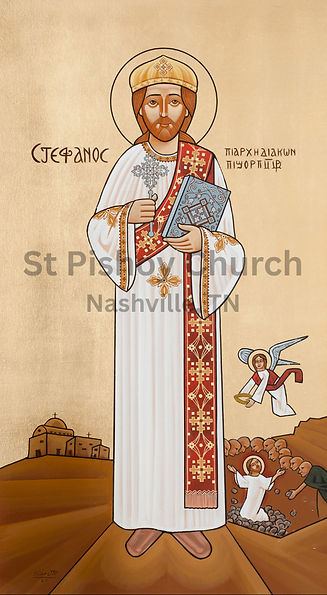
St. Stephen the Archdeacon & Proto-martyr
St. Stephen was an archdeacon and the first martyr (protomartyr). He was chosen among six other deacons full of the Holy Spirit, wisdom, and faith for the diaconate service and the ministry of the poor. Stephen preached and did great wonders and signs among the people. His personality and miracles incited the envy and resistance of the Hellenistic Jews who were not able to oppose the wisdom and the Spirit by which he spoke.
The Jews seized him and brought him before the council. They accused him of blaspheming against the temple and the law. Stephen stood before them and reviewed his argument in a profound historical and elaborate illustration. His words were convincing and fiery and they saw his face as the face of an angel. They ran at him with one accord, cast him out of the city, and stoned him as he was calling on God, saying, “Lord Jesus receives my spirit.” He saw the glory of the Son of Man standing at the right hand of God. Then, he knelt down and cried out with a loud voice saying, “Lord, do not charge them with this sin.” And when he had said this, he fell asleep. Devout men carried St. Stephen's pure body and buried him with great veneration. The blessing of his prayers be with us all. Amen.
Features of this Icon:
-
St. Stephen is depicted wearing the traditional Coptic Orthodox vestments of an archdeacon. This includes the tonya, badrasheel (stole), and cap/crown. This is not to say that these were the vestments he wore, but since it is a Coptic icon, he is vested in the traditional Coptic vestments.
-
In the bottom right, we see St. Stephen being stoned and lifting his head, gazing up to heaven and raising his hands and praying as is mentioned in Acts 7:55-60, “But he, being full of the Holy Spirit, gazed into heaven and saw the glory of God, and Jesus standing at the right hand of God, and said, “Look! I see the heavens opened and the Son of Man standing at the right hand of God!” Then they cried out with a loud voice, stopped their ears, and ran at him with one accord; and they cast him out of the city and stoned him. And the witnesses laid down their clothes at the feet of a young man named Saul. And they stoned Stephen as he was calling on God and saying, “Lord Jesus, receive my spirit.” Then he knelt down and cried out with a loud voice, “Lord, do not charge them with this sin.” And when he said this, he fell asleep.” We also see the angel placing the crown of martyrdom on St. Stephen’s head.
.png)
Christ Teaching in the Temple as a 12 year old
This story is found in the gospel of St. Luke 2:41-52:
Every year, Jesus’ parents went to Jerusalem at the Feast of the Passover. When He was twelve years old, they went up to Jerusalem according to the custom of the feast. When they had finished the days, as they returned, the Boy Jesus lingered behind in Jerusalem, and Joseph and His mother did not know it. Supposing Him to have been in the company, they went a day’s journey and sought Him among their relatives and acquaintances. When they did not find Him, they returned to Jerusalem, seeking Him.
Now so it was that after three days they found Him in the temple, sitting in the midst of the teachers, both listening to them and asking them questions. All who heard Him were astonished at His understanding and answers. When His parents saw Him, they were amazed; and His mother said to Him, “Son, why have You done this to us? Look, Your father and I have sought You anxiously.”
And He said to them, “Why did you seek Me? Did you not know that I must be about My Father’s business?” But they did not understand the statement which He spoke to them.
Then He went down with them and came to Nazareth, and was subject to them, but His mother kept all these things in her heart. And Jesus increased in wisdom and stature, and in favor with God and men.
Feature of this Icon:
-
We see Jesus standing in the middle, with His hands in a teaching position, to show that He was instructing the teachers and elders of the temple.
-
We see the teachers and priests holding scrolls and tablets, representing that they knew the Old Testament and the Law but were still amazed at how much Jesus knew.
_edited.jpg)
St. George of Rome, the Prince of Martyrs
St. George was born in Cappadocia in Asia Minor (today ‘Turkey’) in the first half of the third century to a wealthy and godly Christian family. His father’s name was Anastasius, the governor of Melitene in Cappadocia. His mother's name was Kira Theognosta (Theopista), the daughter of the governor of Lydda in Palestine. St. George had two sisters named Kasia and Mathrona. Their father died while they were still young and their godly mother took charge of raising them up in Christian piety. His mother took them back to the city of Lydda in Palestine, her homeland.
When George grew to be a courageous and brilliant young man, Justus, the governor of Palestine, took interest in him and enlisted him in the army. He learned horsemanship and was promoted in the ranks until he reached the rank of commander. Meanwhile, Justus the pious governor of Palestine departed.
Dadianus, a Persian king, was ruling in the city of Tyre in Syria. When George returned from the army and went to Lydda to visit his mother, he found that the king had issued an edict to worship the idols and torture the Christians who do not obey his orders. Accordingly, most of the people worshipped the idols and raised incense to them; no one dared to resist or profess Christianity openly. George came before King Dadianus and confessed the Lord Christ. The king marveled at his appearance and courage and was informed that he was the son of an eminent governor. The king befriended him and tried to persuade him with many promises to offer incense to the idols to grant him all his wishes. George refused all the earthly futile promises and stood firm in his loyalty to his Christ and his faith.
The king was furious and ordered to torment him with the severest and most horrific kinds of tortures. They placed him in the Hinbazeen which tore his body and his blood gushed. Then, they cast him in quicklime for three days, but the Lord protected him.
The king attributed this protection to sorcery. They put on him shoes made of iron with red hot nails and beat him with sticks to force him to walk, while mocking him. They scourged him with ox tails until his blood gushed. Through all these tortures, the Lord consoled him and healed his wounds. George kept his serenity and calm face and the king and the provincial governors who were condemning him to all these tortures, marveled.
The king brought a magician named Athanasius, who gave George a cup full of deadly poison to drink. St. George made the sign of the cross over the cup then drank it, and no harm came upon him. They gave him another cup after they had tied his arms behind his back. He asked them pointing with his head; “do you want me to drink from here or from there or from here or here?” In this way, he made the sign of the cross over the cup with his head. He drank it, but again it did not harm him. Athanasius the magician believed in the Lord Christ The king ordered to behead him and thus he received the crown of martyrdom. The king and his fellow governors, because of their stubbornness, attributed the miracles again to sorcery.
Dadianus asked St. George to accompany him to the pagan temple to offer incense to the gods. The saint pretended to agree and the king rejoiced. He gathered all the noble men of his kingdom and St. George went along with the king. In the temple, the saint talked to the idol and asked him to state clearly his true identity. The devil was forced to speak from the idol and said, “I am not a god myself or any other idol like me. But the true God is the One that you are proclaiming.” Immediately after, all the idols fell and were destroyed. The priests of the idols became furious and stirred up the people, screaming in the face of the king saying, “Take his life, for we can’t tolerate seeing him anymore.” Because of this miracle, Queen Alexandra, Dadianus' wife, believed in the Lord Christ and was martyred.
Finally, Dadianus ordered the beheading of the saint. In the place of execution, St. George prayed a fervent prayer then extended his neck to the swordsman who cut off his holy head and he received the crown of martyrdom. A Christian took the body and the head, wrapped them in expensive shrouds, and took them to his hometown Lydda in Palestine where they built a church after his name and placed his pure body in it. The blessing of his prayers be with us all. Amen
Features of this Icon:
-
We see St George riding a horse and wearing a soldier’s uniform symbolizing him being a commander and soldier in the army.
-
We see an angel placing the crown of martyrdom on his head.
-
We see him slaying a dragon which symbolizes him overcoming the devil through the power of God. The dragon is shown from his side profile and green. These depictions in Coptic iconography are reserved for the devil and those who are evil.
St. Mark and the Theological School of Alexandria

This icon dates back to the first century A.D. According to tradition, after St. Mark preached in Alexandria and many began to convert, there arose a need for a school to teach the true faith and to combat the philosophical and pagan schools for which Alexandria was famous.
This icon corresponds with the icon of St. Pishoy on the opposite side. The Coptic Church is known for three major pillars: preserving the true faith and teaching, martyrdom, and monasticism. Here, we see St. Mark seated on the shore of Alexandria, teaching his children. Thus, in this icon, we see two of the major elements for which the Coptic Church is renowned: preserving the faith and martyrdom.
Features of this Icon:
-
St. Mark is seated in the middle, holding a cross to represent that he came and preached the death and Resurrection of Christ.
-
Behind him are the Mediterranean Sea and the ancient Library of Alexandria, showing that this scene takes place in Alexandria, Egypt.
-
The pillar on the left represents the verse in Isaiah 19:19, which states, “In that day there will be an altar to the Lord in the midst of the land of Egypt, and a pillar to the Lord at its border.”

Jonah in the Belly of the Whale
This icon’s story is found in the Book of Jonah, chapters 1–4. This particular scene depicts Jonah being spat out of the belly of the whale (Jonah 3).
This icon is placed here because Jonah is a symbol of Christ’s burial in the tomb for three days and His Resurrection on the third day. It is positioned beside the icon of the Resurrection of our Lord Jesus Christ to reflect this connection.
Features of this Icon:
-
We see Jonah emerging from the whale, holding the prayer he prayed while in its belly, as found in Jonah chapter 2.
-
In the background, we see the great city of Nineveh, symbolizing that he went there after being spat out of the whale.
Icon of Dream of St Joseph the Carpenter, angel telling him to take his family and flee to Egypt
_edited.jpg)
This icon is the beginning of the icon on the other side. This icon shows the angel coming to St. Joseph in a dream, telling him to take Christ and St. Mary and to escape to the land of Egypt.
Features of this Icon:
-
We see a vision of St. Joseph taking Christ and St. Mary to Egypt and the Pyramids and the Temple of “Abu Simbel” in the background.
-
We see St. Joseph sleeping and behind him is Bethlehem, showing the location where the Holy Family stayed before escaping.

Resurrection of Our Lord Jesus Christ
In the year 34 A.D., the Lord fulfilled the economy of salvation and redemption with His Holy Resurrection from the dead and became the first-fruit of those who have fallen asleep.
This event is mentioned in all four gospels, Matthew 28, Mark 16, Luke 24, John 20&21.
We ask our Good Savior to raise us from the death of sin, forgive our trespasses and grant us the eternal life, and glory be to our God forever. Amen.
Features of this Icon:
-
We see Christ Resurrected and wearing white with the mark of the nails on His wrists and feet. We see Him holding a banner with a cross on it showing Him conquering death and granting us life again.
-
The stone is still covering the tomb symbolizing that Christ resurrected before the removal of the stone and the removal of the stone was a proclamation of His resurrection.
-
We see two angels. These were the angels that the women saw at the head and foot of the place where Jesus’ body laid.
-
On the left we see the women carrying the spices that came to the tomb Sunday morning to anoint Jesus’ body.
Icons of the Twelve Disciples

The icons of the twelve disciples are positioned on both sides of the Iconostasis (six on each side). These icons are placed here to symbolize that by the teachings of the disciples, the whole world was illuminated and all nations were restored to the true faith. They are placed in the order found in Matthew 10:2-4.
Features of these Icons:
-
All the disciples are either holding a cross, a letter, or a gospel. These symbolize that they preached Christ’s death and the message of the good news to the whole world.
-
The disciples are all wearing white symbolizing purity, blue symbolizing that their eyes were on heavenly things and not earthly things, red because they witnessed for Christ or shed their blood for Him, and brown as a sign of dignity.
Icon of the Last Supper

The Last Supper is the event where Christ instituted the sacrament of the Eucharist. The Coptic Church believes that the bread and wine used in Communion are changed into the true Body and Blood of Christ in a mysterious way. This icon is placed above the altar door as a reminder of the One who instituted the sacrament that takes place during the liturgy.
Features of this Icon:
-
Christ is at the center, with the eleven disciples seated around Him, and St. John the Beloved resting his head on Christ as he used to do.
-
Christ is holding His Body in His hand, and before Him is a chalice containing His Blood.
-
Judas is not present in the icon, symbolizing that he left before the Eucharist took place.
.jpg)
Crucifixion of Our Lord Jesus Christ
The Crucifix is placed at the top of the iconostasis symbolizing that Christ was raised on the cross and through the cross we are saved.
Features of this Icon:
-
Above Christ is a cherub symbolizing what is written in Psalm 45:6, “Your throne, O God, is forever and ever;” and Psalm 96:10, “The Lord reigns on wood” symbolizing that the cross was His throne and as we read in Revelation, that the throne is carried by the cherubim.
-
We see under the cross a skull and Christ’s blood coming on it. This symbolizes two things: (1) that Christ’s blood covers all of humanity past, present, and future, and is there for those who accept Him and are baptized and (2) Jewish tradition has it that this is the place where Adam was buried and this shows that Christ fulfilled His promise to Adam and Eve, that from them would come the One who would save them.
-
We see St. Mary the Mother of God and St John the Beloved on the left and right as they were the closest to the cross during the crucifixian.