
Church Icons
The History of Coptic Iconography
During the times of the Pharaohs, around 4400 BC-332BC, art was commonly used because many people were illiterate. The Egyptians had seen these images as living art which conveyed the power of the gods and their union with humanity. This would later impact the style of icons. Around 332 BC-395 AD, there was a rise in Greco-Roman art. This style of portraits were of people who had passed or were extremely influential.
Church tradition traces the very first icons of Christ during His lifetime or immediately after His ascension. During the second century, many icons were of joyful moments, such as the Wedding of Cana or Palm Sunday, in order to be inviting to the new converts. In addition, many of these icons were written directly on walls, which is a style called fresco.
In the fourth century, after the era of martyrdom, many of the icons focused on the second coming of Christ, so they portrayed Christ on the throne, the four living creatures, clouds, angels, etc. Thus this period became known as the Eschatology era. Many of the church fathers at this time were praising the effects the icons had on the spiritual life of the believers. St.Basil the Great said, “ Arise now before me, you iconographers of the saint merits… Let me be conquered by your pictures of the valiant deeds of the martyr!... Let me look at this fighter most vividly depicted in your image!... Let the Instigator of the fight, Christ, be presented in your picture!”

During the fifth century, we start to see a rise in dedicated icon writers and continue to see more church fathers, such as St. Augustine, comment on icons.

Around the seventh century to around the eleventh century, the number of icon writers in Egypt decreased due to the Arab invasion. Many monks in the monasteries would cover the icons with a mixture of sand and water to protect it from being destroyed. Centuries later these icons were perfectly preserved through constant prayer. The candles that were lit during prayer, made smoke which created a protective layer, this prevented damage from the sand. Depending on the leader of Egypt at the time, sometimes there would be violence towards the church and sometimes the leader would show kindness toward the church allowing them to build more churches and write more icons. Many of the icons, similar to those found in the monastery, had medieval Egyptian style of clothing and color palates. Meanwhile, the Monastery of the Syrian and other churches had commissioned artists from Syria, Armenia, and Jerusalem to write icons due to a lack of iconographers in Egypt. Though often these artists had brought over their style of icons, the church of Egypt made sure to choose icons that were theologically accurate.

From that point on till around the eighteenth century there had been a disappearance of icononographers in Egypt. Then came Yuhanna Al- Armani and Ibrahim Al- Naskih who taught and produced over 400 icons over a fifty year period. Their work can mostly be found in the churches of Old Cairo. They became the revivers of medieval and antique iconography, and reinstated icons as liturgical objects.

But in the nineteenth century, due to the European colonists, a lot of western art was used in the church. But to avoid any confusion the church had chosen pictures that fit into the Coptic theology. For example, the painting of the baptism of Christ by Leonardo Davinci was rejected due to the fact that Christ was sprinkled rather than fully submerged in the water.
During the twentieth century, Pope Kyrillos the sixth had commissioned Dr. Issac Fanous, who had studied iconography in France, and founded the art department of the Higher Institute of Coptic Studies. Dr Fanous focused on blending biblical and theological ideas with the pharaonic style of art in his icons.
Features of Coptic Icons
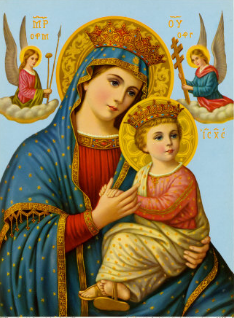
Icons have a sense of joy even if they were martyrs who were tortured because now they are now in the paradise of joy. There is also the spirit of victory, usually satan is proportionally smaller and under the saint’s feet because they have overcome evil. The power of spirit, typically portraits have a larger body and smaller head, but in coptic icons it is reversed in order to emphasize that the power of the spirit should be over the body. Even if the saint had departed at a younger age they are still depicted with forehead lines usually found in older people to show how wise the saints are despite age. The majority of the saints are depicted in a position of prayer, showing the importance of constant prayer. The saints are shown from the front while the evil such as the devil have a side profile. Icons are not limited to time or space, saints that may have lived in different places and in different times can be depicted together since they are now together in paradise. Even the colors used in the icons have meaning; gold or yellow represents holiness or heaven, white represents purity, red represents redemption, blue represents eternity, and olive green represents evil.
Sources:
The church, house of God by Fr Tadros Y. Malaty
Our Iconographers

Mr. Raaof Rizkallah Saad
-
Born in Desouk, Egypt on March 3, 1974
-
Graduated with a Bachelor of Fine Arts, from Alexandria University in 1996
-
Studied Coptic Iconography since 1993
-
Member of the Fine Artist Association
-
Award winner of Atilait Salon 1998 in Alexandria, Egypt
-
Lecturer at Pope Shenouda III College in Vienna (The History of Coptic Icons)
Mrs. Hanan Awad
-
Born in Damanhour, Egypt on February 16, 1974
-
Graduated with a Bachelor of Fine Arts from Alexandria University in 1996
-
Studied Coptic Iconography since 1993
-
Member of the Fine Art Association
Both Mr. Raaof and Mrs. Hanan are world renowned iconographers completing churches in Egypt, the United States, Europe, Jerusalem, and many more countries. The most famous projects that have been completed include: the Iconostasis and Icons in the main church at St Mark’s Cathedral in Abbaseya, Cairo, Egypt, the Papal Headquarters across from the Cathedral , and The Bosom of the Father and the downstairs church of the Cathedral of the Nativity in the New Administrative Capital in Egypt. We are blessed to have had them write the icons of our church including the three bosoms, the iconostasis, the main church, the ceiling, the baptistery, the lobby, and procession icons. We pray that God may reward them for all their labor thirty, sixty, and a hundred-fold.